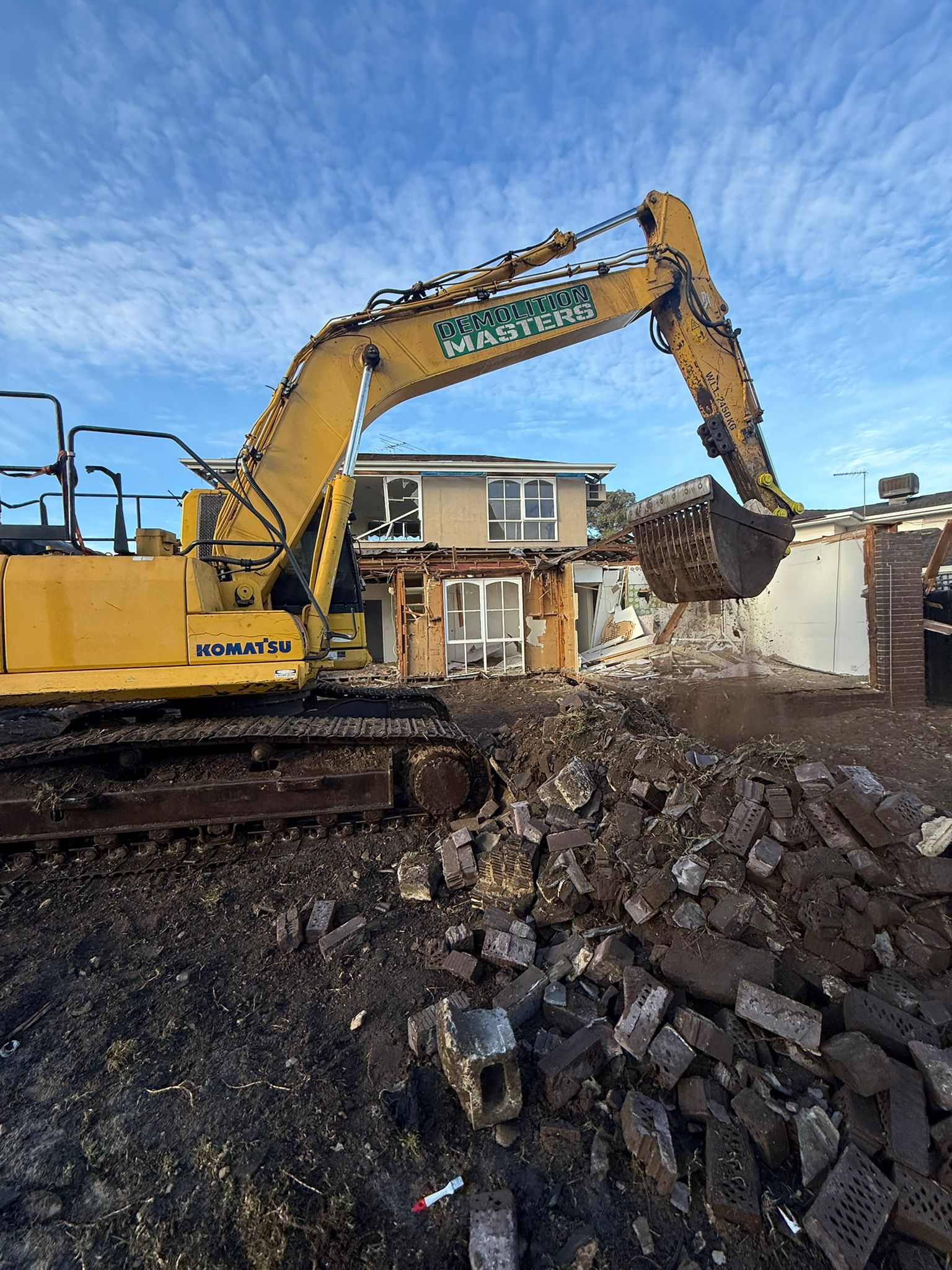
Inner-city Melbourne lots — Fitzroy, Brunswick, Carlton, Richmond, Collingwood, South Melbourne — are often less than 6 metres wide, with side passages narrower than a wheelbarrow, no rear lane, neighbours sharing both side boundaries, and a single street-front for all access. Demolishing on a lot like that requires different equipment, different sequencing, and significantly more planning than a suburban quarter-acre block. Here is how it actually works.
What makes inner-city work different
Five things separate inner-city demolition from outer-suburban:
- No vehicle access except through the front of the property
- Side passages too narrow for standard machines
- Boundary walls shared with neighbours on both sides
- Truck rotation limited by street width and parking restrictions
- Acoustic and dust impact on dense surrounding properties
Each of these adds time, cost, or both. Together they mean the same building demolished on a tight lot can take 50–100% longer than on a clear suburban block.
Equipment selection
The difference between a 14-tonne and a 5-tonne excavator dictates everything else about the project. On a wide block, a 14-tonne machine clears a single-storey weatherboard in two days. On a 4-metre side passage, that machine doesn't fit, so a 5-tonne goes in instead — same building takes 4–5 days.
The work-around is to plan equipment around the bottleneck:
- Mini excavator (1.5–3 tonne) for surgical work near boundaries
- Compact excavator (5 tonne) for the bulk of the work where it can fit
- Mid-size excavator brought in only when the structure is partially down and access has opened up
This staged equipment approach adds days but is often the only way to maintain progress without damaging adjacent property.
Truck rotation logistics
A standard demolition truck is around 11 metres long, 2.5 metres wide. On a typical inner-city street with parked cars on both sides, only one truck can stage at a time. As that truck loads, the next one has to wait either further down the street or back at the depot.
Solutions:
- Council parking restriction permit — temporarily clear the kerb adjacent to the site for the duration of works. Requires application 1–2 weeks ahead.
- Off-site truck staging — trucks queue at a holding point and rotate one at a time on demand. Adds coordination overhead but keeps the street usable.
- Smaller truck fleet — 8-tonne tippers instead of 16-tonne. More trips but better access.
The right combination depends on the specific street. The contractor should walk the access on the day of quoting, not assume from satellite imagery.
Boundary wall protection
When the demolition target shares a boundary wall with a neighbour, that wall has to stay standing while everything on the demolition side comes down. Methods:
- Hand demolition along the line — the last metre against the boundary is removed manually, not with the machine. Slow but precise.
- Engineering inspection of the retained wall — confirms the wall can stand independently after the supporting structure on the demolition side is removed.
- Temporary support — sometimes a brace or shore is installed on the neighbour's side (with their consent) until the new construction ties in.
- Pre-condition photographs — every part of the boundary wall photographed before works start, so any subsequent damage claims have a clear baseline.
Inner-city neighbours are not optional stakeholders — their cooperation makes everything easier and their objection can stop a job. A genuine conversation before works begin, with phone numbers exchanged and a clear schedule shared, prevents 90% of inner-city demolition complaints.
Dust suppression
Dense neighbourhoods amplify the impact of demolition dust. Standard practice:
- Continuous water spray during structural demolition
- Misting fans for fine dust during specific operations
- Daily site sweep of street and footpath
- Dust monitors during especially sensitive operations (hospital adjoining, school nearby)
The cost of these is minimal compared to the cost of complaints. Inner-city contractors who skip dust suppression generate council notices, neighbour disputes, and stop-work orders.
Acoustic management
Council noise regulations are stricter in dense residential areas. Expectations:
- Standard council hours strictly observed (usually 7am–6pm weekdays)
- No machine work before 8am even within council hours, by gentleman's agreement with neighbours
- Saturday work limited to non-noisy activities
- Acoustic barriers (temporary timber hoarding lined with absorptive material) around particularly loud operations
- Particular care in winter when windows are closed and complaints are amplified
Sequencing for tight lots
The sequence on a tight lot is different from a suburban block. Typical order:
- Soft strip and asbestos removal first — done while the structure is fully intact, easier access
- Roof down — sheets stripped manually, dropped through openings, no perimeter scaffolding required
- Upper storey demolished from inside-out — material drops down through the building footprint rather than over the side
- Lower storey demolished from front to back — keeps the front access clear for trucks
- Slab break is the last machine work, with the structure already gone
- Final clean — extra effort because dust and debris settle further on tight sites
What the homeowner should expect
Inner-city demolitions almost always take longer than the suburban-equivalent timeline suggests. General timing guide assumes flat suburban conditions; expect 30–50% more time for tight lots.
The cost premium is also real — typically $4,000–$10,000 extra for residential, more for complex sites. The premium reflects the genuine complexity, not contractor opportunism.
Pricing factors specific to tight sites
- Smaller (slower) equipment
- More truck rotation
- Manual demolition along boundaries
- Additional dust and acoustic measures
- Council parking permits
- Engineering inspection of boundary walls
- Pre-condition photography of every adjoining property
- Additional public liability cover for tight access
- Often a higher contingency for unforeseen items (party wall conditions, hidden services, made ground)
What to ask a contractor for inner-city work
Beyond the standard 10 questions, two specific to inner-city work:
- "Can you show me a recent inner-city demolition you've completed in this kind of street?" — generic suburban experience doesn't transfer well
- "What's your approach to neighbour communication, and can I see the template you'll use?"
The right contractor has done this work many times. The wrong one is about to learn on your site.
Why it can still be worth it
Inner-city demolition is harder, slower, and more expensive than outer-suburban. It's also exactly what enables the renewal of Melbourne's most valuable suburbs. A heritage Victorian on a 5-metre-wide lot in Fitzroy or Carlton, demolished and rebuilt thoughtfully, becomes a multi-million-dollar home in one of the world's most liveable cities. The cost premium is real but so is the underlying value. Plan for it, hire for it, and the project delivers.