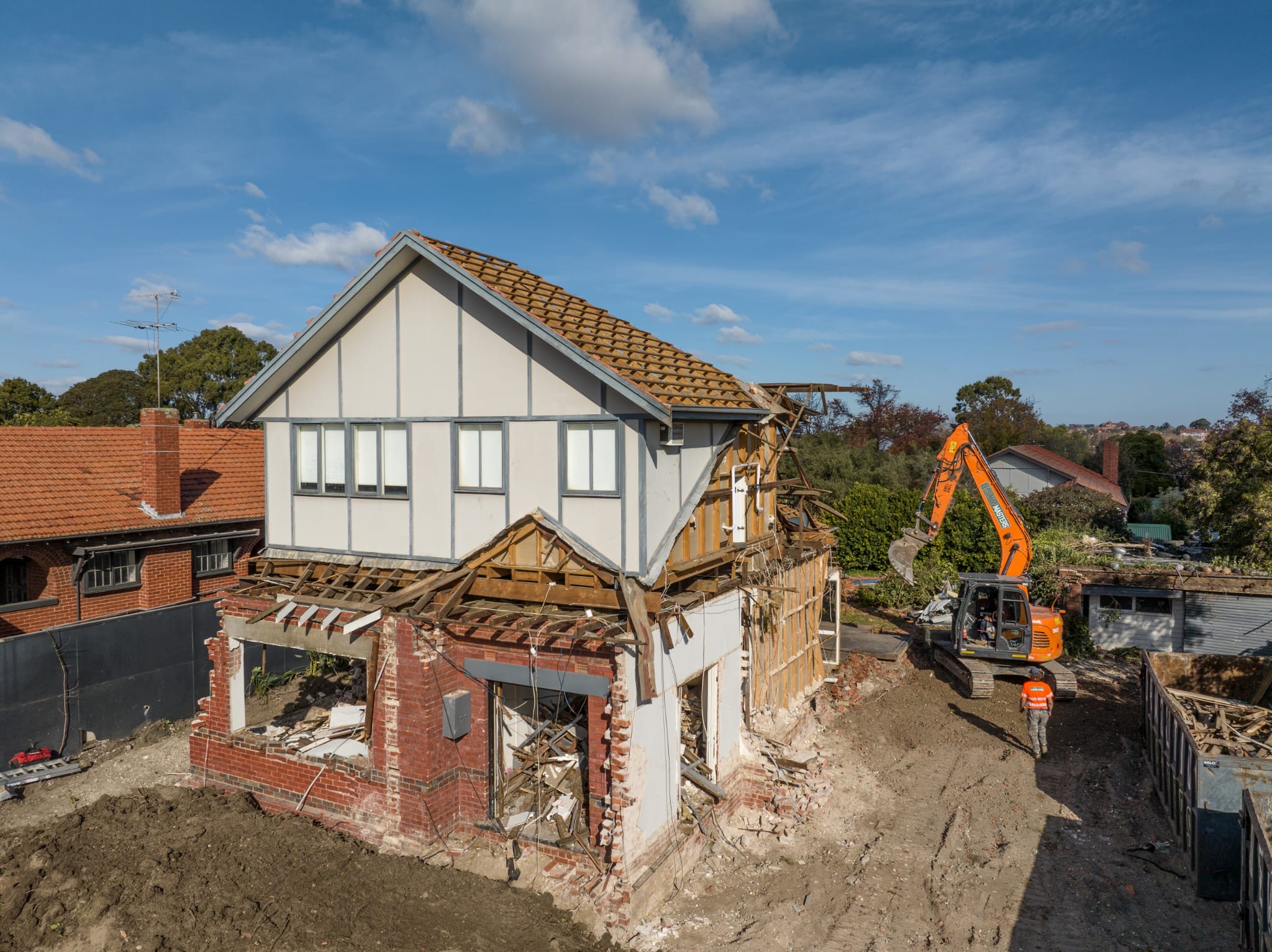
Demolishing one shop in a strip mall while the others stay open. Stripping out a tenancy on level 14 of an office tower while every other floor continues trading. Demolishing the rear of an old building to extend it, while the front continues to serve customers. Trading-adjacent demolition is one of the most operationally complex types of work — and it's everywhere in commercial Melbourne. Done right, none of the businesses next door lose a customer or a day of trade. Done wrong, the contractor faces complaints, claims, and contract failure. Here is how the right way works.
The five layers of trading-adjacent demolition
Five distinct things have to be managed, often simultaneously:
- The structural work itself — demolishing safely without affecting the retained structure
- Acoustic impact — keeping noise within tolerable limits during trading hours
- Dust and air quality — preventing contamination of adjoining occupied space
- Access and traffic — keeping customer access, deliveries, and pedestrian flow uninterrupted
- Communication — keeping every stakeholder informed enough that surprises don't happen
Each layer has its own techniques, its own cost, and its own failure modes.
Programme staging
The fundamental tool for trading-adjacent work is staging — splitting the demolition into phases, with each phase scheduled around the trading day.
Common staging patterns
- After-hours only: All noisy work between 6pm and 7am while businesses are closed. Quiet preparation work allowed during trading hours.
- Sunday and public holidays: Larger blocks of intensive work scheduled for closed-business days.
- Pre-opening: Heavy work done before businesses open at 9–10am, finishing in time for trading start.
- Phased zones: Demolishing zone by zone, with each zone fully separated from the trading area before work begins.
The right pattern depends on the specific situation. A 24-hour CBD office building is different from a suburban strip mall is different from a hospital adjoining a residential demolition.
Acoustic management
Acoustic isolation around trading-adjacent demolition is a real engineering exercise:
- Temporary acoustic hoarding — timber walls lined with rockwool and acoustic-rated panelling can reduce demolition noise by 15–25 dB
- Acoustic blankets — heavy mass-loaded vinyl curtains hung around particularly noisy operations
- Vibration isolation — softer machinery (electric crushers vs hydraulic hammers) when adjoining trades are sensitive
- Acoustic monitoring — calibrated meters at the boundary, real-time monitoring during sensitive operations
Acoustic measures add 10–25% to typical demolition costs but are non-negotiable when adjoining trade is active.
Dust and air quality
Trading-adjacent dust control goes beyond standard suppression:
- Sealed-zone demolition — the demolition area is enclosed in a polythene-sealed enclosure with negative-pressure ventilation
- HEPA-filtered air extraction — air pulled out of the zone, filtered, exhausted away from occupied areas
- Trading-area air monitoring — real-time particulate monitoring inside adjoining shops or offices
- Daily clean cycles — trading area floors and surfaces cleaned at the end of each shift
For shopping centre work in particular, dust complaints are the most common reason a project gets shut down mid-way. Investment in air quality control is investment in completing the contract.
Major Melbourne shopping centres have specific contractor standards for trading-hours work — sealed enclosures, air monitoring, end-of-shift cleaning, daily sign-off with centre management. Contractors without recent shopping centre experience often underestimate the overhead.
Access and traffic management
Five practical considerations:
Customer pathway
The path customers use to reach adjoining shops or offices must remain open, well-lit, and visibly safe at all times. Where the demolition encroaches on a normal pathway, an alternative route should be marked and signed. Hoarding should be respectable, not ad-hoc construction fence with cable ties.
Loading and deliveries
Adjoining businesses still need their daily deliveries. The contractor's truck rotation has to fit around delivery times, often with a daily schedule shared with all parties.
Shopfront visibility
Customers can't shop at a store they can't see. Hoarding around demolition should not block the adjoining business's shopfront, signage, or visibility from the street.
Pedestrian safety
Continuous, well-lit pedestrian protection. Overhead protection where works are above pedestrian flow. Visible spotters during truck movement.
Out-of-hours access
Adjoining businesses sometimes need access at unusual times — emergency call-outs, weekend stocktakes. The contractor's site arrangements should accommodate this.
Communication architecture
Trading-adjacent demolition requires structured stakeholder communication:
- Pre-start meeting — sit down with each adjoining business owner before works begin. Walk through the programme, the noise schedule, the access arrangements, the contact numbers.
- Weekly progress emails — short summary of the past week and the look-ahead. Sets expectations and demonstrates accountability.
- Real-time problem channels — a phone number that is actually answered. The site supervisor's mobile, not a generic office line.
- Daily sign-off where needed — for centre management or building management, a quick end-of-day check-in keeps issues small.
The same communication architecture applies whether the trading neighbour is a single shop or an entire mall.
Handling complaints
Complaints will happen, even with the best management. The protocol:
- Acknowledge within an hour
- Investigate on-site within 24 hours
- Adjust if the complaint is valid (different methodology, different timing)
- Communicate the resolution to the complainant directly
- Document for the project record
Most complaints settle quickly when the contractor responds professionally. Complaints escalate when the contractor is dismissive or absent.
Insurance considerations
Trading-adjacent demolition increases the contractor's insurance exposure significantly. The public liability cover should explicitly extend to:
- Loss of trade caused by demolition activities
- Property damage to adjoining premises
- Personal injury to customers, staff, or visitors of adjoining businesses
Standard $20m public liability cover is usually fine for adjoining residential. For commercial-adjacent or shopping centre work, $50m+ is normal. Insurance detail.
Cost premium for trading-adjacent work
Compared to equivalent demolition with no adjoining trade, trading-adjacent work typically adds:
- +25–50% for acoustic and dust measures
- +30–80% for after-hours premium where applicable
- +5–10% for additional public liability cover
- +10–20% for staging overhead and supervision
The premium is real, but it reflects genuine cost. Contractors who quote at standard rates for trading-adjacent work either don't understand the requirements or are planning to cut corners. Either way, it's a problem.
Choose the contractor that has done this before
Trading-adjacent work is the type of demolition where contractor experience matters most. The systems for managing concurrent business operations don't develop overnight — they're built up over many similar projects. Ask specifically for similar work in similar settings, and ask the previous client whether the trading was actually uninterrupted. Contractor selection detail.
Done well, nobody notices
The mark of a successful trading-adjacent demolition is that the adjoining businesses, six months later, will struggle to remember when the works happened. They knew about it during the job, of course — but their customers kept coming, their deliveries kept arriving, their shopfronts stayed visible, and their day didn't change. That outcome is achievable. It just requires the right systems, the right contractor, and the right budget.