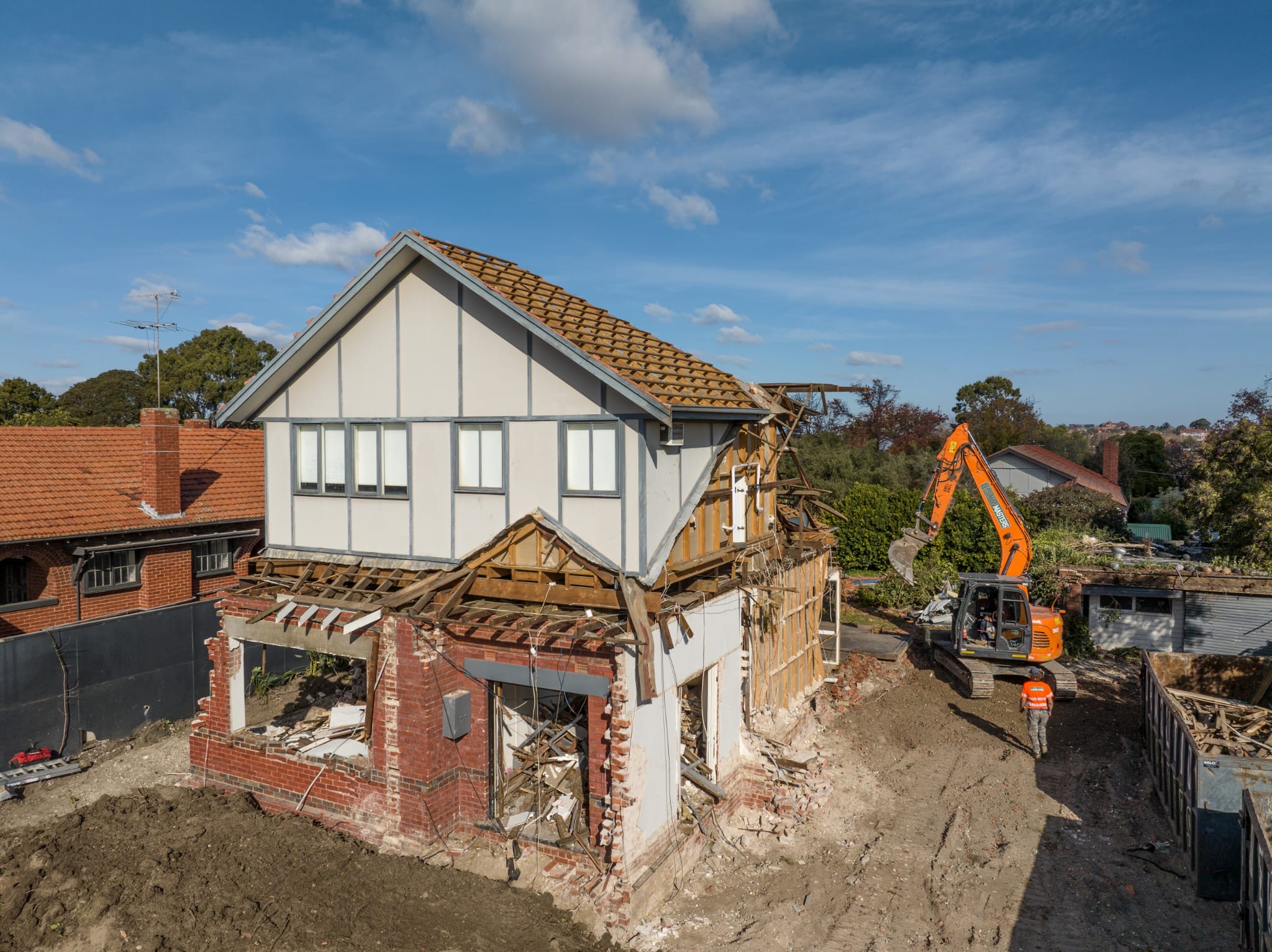
Office strip-outs are the quiet end of demolition work. Partitions, ceilings, floor coverings, fit-out joinery, services pulled back to base building — gone in days, scheduled around tenants who never see the crew. Done well, the only evidence is an empty floor delivered ready for the next fit-out. Here is how Melbourne office strip-outs actually work.
What gets stripped out
A standard office strip-out removes:
- Partition walls — usually plasterboard on metal stud, sometimes glass
- Suspended ceilings (T-bar grid + tile or plasterboard ceiling)
- Carpet, carpet tiles, vinyl, raised floor systems
- Joinery — reception desks, kitchens, meeting room fit-outs
- Office services — cabling, power, data outlets, AV cabling
- Air conditioning fit-out items (diffusers, duct branches, controllers)
- Lighting fixtures and lighting controls
- Doors, frames, and signage
- Built-in furniture, demountable walls, and shopfitting
- Window treatments and acoustic treatments
What stays is the "base building" — structural slab, columns, perimeter walls, core, base mechanical and electrical risers. The result is a clean blank shell ready for the next tenant's fit-out.
Why strip-outs run differently from demolitions
Three structural differences shape the approach:
1. Building stays operational
Most office strip-outs happen in buildings where other floors are occupied. The lifts run normally, the ground floor lobby has trading retail, the next-door tenants are in meetings. Everything the strip-out does has to fit around active building operation.
2. After-hours work is normal
Most major Melbourne office buildings restrict construction work to outside business hours. Crews start at 6pm, work overnight, finish at 6am, and the building reopens to staff with no visible activity. After-hours premium is built into the price.
3. Lift logistics dominate
All material has to leave through the goods lift. A 12-tonne goods lift moves slower than the truck waiting at the loading dock. Lift bookings, hoisting capacity, and rotation pattern dictate the daily output more than crew size.
Typical programme for a Melbourne office strip-out
| Floor area | Typical programme |
|---|---|
| Single floor up to 500 m² | 5–10 nights |
| Single floor 500–1,500 m² | 10–20 nights |
| Multi-floor 5,000+ m² | 4–10 weeks |
| Whole-building strip-out | 8–16 weeks |
Programme is heavily affected by lift availability, building access hours, and the speed of waste removal from the loading dock.
The actual strip-out sequence
- Pre-strip survey — identify any asbestos, hazardous materials, retained items
- Soft strip — chairs, desks, freestanding furniture, removable items
- Cabling pull-back — data, power, AV cables back to base building
- Ceiling removal — tiles, grid, light fittings, smoke detectors removed and quarantined
- Partition removal — plasterboard knocked off both sides, studs cut and bundled
- Joinery removal — kitchens, reception desks, meeting room fit-outs cut up and removed
- Floor finishes — carpet rolled and removed, vinyl scraped, raised floor lifted in panels
- Air conditioning fit-out — diffusers, duct branches, controls returned to base
- Final clean — slab swept, walls cleaned, ready for next fit-out
Pre-1990 office buildings frequently contain asbestos in vinyl floor backing, ceiling tiles, partition cavity insulation, and fire-rated wall linings. A pre-strip survey is non-negotiable. Asbestos removal detail.
Recyclable streams
Office strip-outs are some of the highest-recycling demolition work in Australia. Typical streams:
- Steel framing — partition studs, ceiling grid, ductwork — direct to scrap recyclers
- Plasterboard — to dedicated gypsum recyclers (Melbourne has multiple)
- Carpet — to specialised carpet recyclers (carpet tiles especially)
- Ceiling tiles — to mineral fibre recyclers
- Cabling — copper recovery is genuinely valuable
- Lighting — fluorescent tubes need separate handling (mercury content), LED for direct re-use
- Furniture — often donated or resold
Recycling rates of 90%+ are typical and often required by ESG-conscious building owners.
Party wall and adjoining tenant protection
Where the strip-out is on a floor adjoining a continuing tenant, additional measures are required:
- Party wall protection — extra plasterboard, acoustic infill, fire-rated linings
- Dust barriers between floor and floor below
- Vibration monitoring during heavy work
- Communication with adjoining tenant on noise schedule
- Building management approval of methodology
Building management coordination
Every commercial strip-out has a building management overlay. The contractor typically needs:
- Pre-start methodology submission for approval
- Insurance documentation reviewed and accepted
- Inductions for every worker entering the building
- Lift booking and dock booking for every load out
- Daily access lists submitted in advance
- Compliance with building security protocols
- End-of-shift sign-off with building management
Building management overhead is real, and contractors who don't know how to manage it create friction.
What separates good strip-out work
Three operational details:
- Speed of dock turnaround. Material on the floor has to be on the truck within hours. Lift rotation has to be efficient. Trucks waiting at the dock are time and money.
- End-of-shift cleanliness. The floor, the lift, the dock, and the lobby pathway should be cleaner at 6am than they were at 6pm. Building managers notice.
- Communication. Daily progress reports, weekly look-ahead schedules, immediate notification of any issues. The building manager and the tenant project lead should never be surprised.
Pricing for office strip-outs
Pricing is usually quoted per square metre, with significant variation by complexity:
- Standard open-plan office: $40–$70 per m²
- Heavy fit-out with joinery and meeting rooms: $70–$140 per m²
- Asbestos-affected buildings: significantly more
- After-hours premium: typically 25–60% over standard hours
- Lift / dock constraints: case-by-case adjustment
For specific quotes, the contractor will need to walk the floor and review the building access arrangements before pricing.
The right contractor for office strip-outs
Office strip-outs are technically simple but operationally complex. The skills are different from residential demolition. Hire a contractor whose recent work includes the building you're in or similar — Melbourne CBD strip-outs in particular have a distinct rhythm that takes experience to master.