The first decision in any major renovation or rebuild is whether to keep parts of the existing structure or knock the whole thing down. Full demolition is simpler, faster, and gives you a blank canvas — but it doesn't always make sense. Partial demolition keeps useful structure, can preserve heritage, and sometimes saves significant cost. Here is how to decide.
What full demolition means
Everything goes. Walls, roof, floors, slab, footings — the entire building is removed and the site is cleared to engineer's specification for new construction. Common situations:
- Knockdown rebuild on a flat suburban lot
- Old single-storey home being replaced with a new double-storey
- Buildings with extensive structural damage or termite infestation
- Properties where the existing layout doesn't suit the rebuild plan
Full demolition is straightforward: clear, fast, and predictable. Process detail here.
What partial demolition means
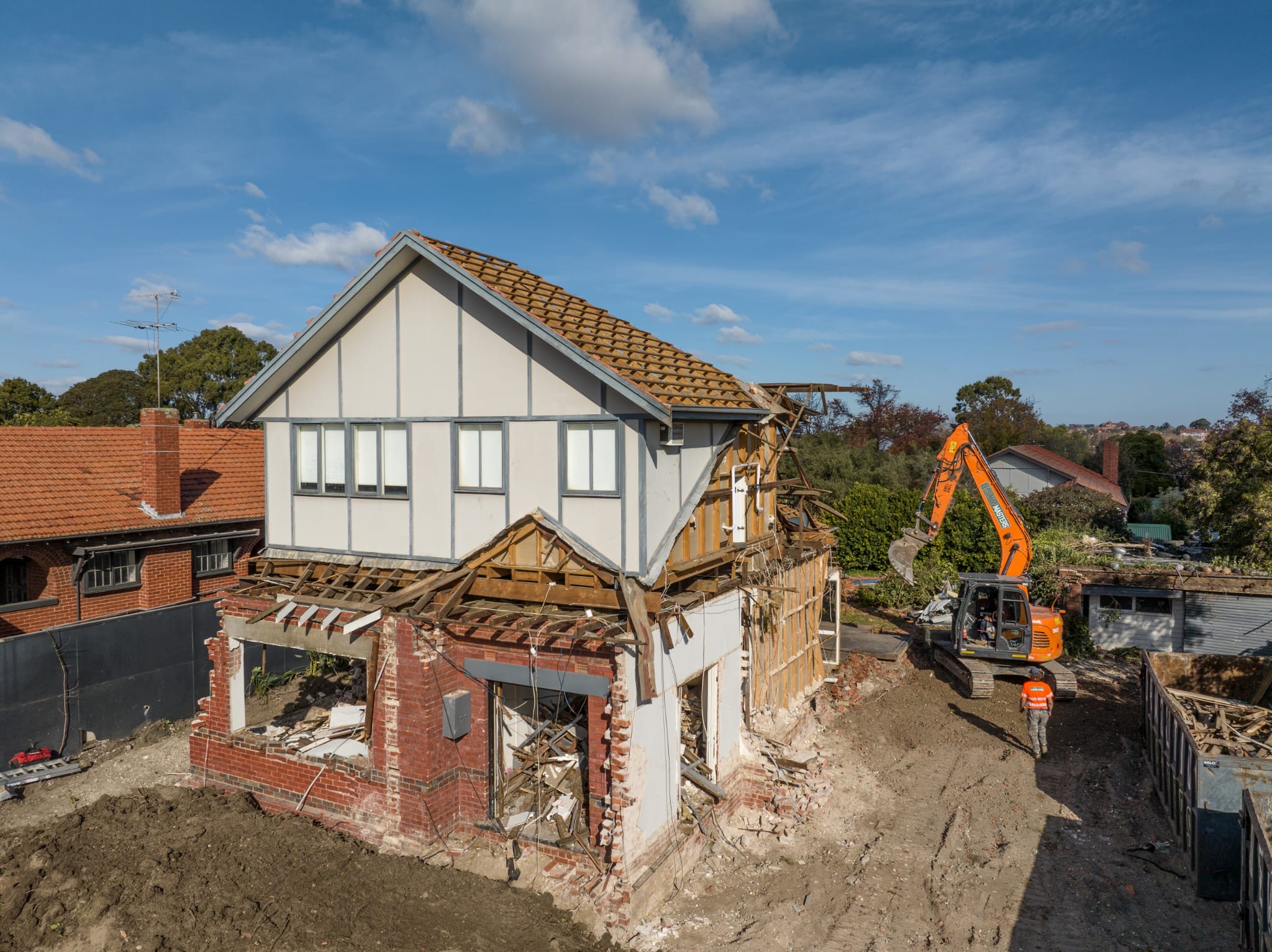
Selective removal — some parts of the building come down, others stay. The retained portion is usually the original structure, and the demolished portion is usually a later addition. Examples:
- Rear extension removal — keep the heritage front, demolish a 1970s rear addition, build a new modern extension
- Facade retention — keep just the street-facing wall and rebuild everything behind
- Strip-out — remove all internal partitions and finishes but keep the structural shell
- Outbuilding-only — remove garage, shed, or granny flat without touching the main house
Partial demolition is technically more difficult because the work has to protect the retained portion while the rest comes down.
Cost comparison
Counter-intuitively, partial demolition is often more expensive than full demolition for similar volumes. Why?
- The work has to be slower and more careful around retained portions
- Temporary structural support may be required
- Smaller machines have to be used in tighter spaces
- Hand-work increases (not machine-work) near retained walls
- Asbestos handling becomes more complex around retained surfaces
| Scenario | Typical Range |
|---|---|
| Full demolition, single-storey weatherboard | $15,000 – $22,000 |
| Partial demolition (rear extension only) | $8,000 – $18,000 |
| Strip-out (internal only) | $10,000 – $25,000 |
| Facade retention + rear demolition | $35,000 – $80,000 |
When full demolition makes more sense
Choose full demolition when:
- The existing building has limited or no heritage value
- The structure is significantly damaged (termites, fire, water damage)
- Your rebuild design is fundamentally different from the existing footprint
- The property is not in a heritage overlay
- You want a blank-slate rebuild without retention constraints
- Cost is the primary consideration and there's nothing worth saving
When partial demolition makes more sense
Choose partial demolition when:
- The property is in a heritage overlay with restrictions on full demolition (heritage detail here)
- The existing structure has features worth keeping — original character, architectural significance
- You only need to extend or modify, not replace
- The existing building is fundamentally sound and only the addition needs replacing
- Council planning rules favour retention over replacement
- The economics of full vs partial favour partial (not always — check with both contractors and a builder)
If you're not sure, get the demolition contractor to quote both options side by side. The cost difference often surprises homeowners — sometimes partial is cheaper, sometimes full demolition is dramatically cheaper.
The structural considerations
Partial demolition introduces structural complexity that full demolition doesn't:
Temporary support
Where you remove a load-bearing element from a building you're keeping, something has to hold up what's left. An engineer designs the temporary support; the demolition contractor installs it; the rebuild then takes over the load. The temporary support adds cost and time.
Tying old to new
The interface between retained structure and new construction is the trickiest detail in any partial demolition. Roof flashings, floor levels, wall thicknesses, structural connections — all need careful planning. The architect and builder need to coordinate with the demolition contractor on exact removal lines.
Existing services
If you're keeping part of the building, you may be retaining its plumbing, wiring, and gas. The retained services may need to be tested for compliance with current standards before being incorporated into the new build. Sometimes "keeping the original" means rebuilding the systems within it.
Heritage implications
For heritage overlay properties, partial demolition is often the only legally available option. Even where full demolition is approved, the partial alternative may be quicker through council. Talk to a planner before deciding. Permit detail here.
Build timeline implications
Full demolition produces a clean, level site that any builder can step onto. Partial demolition produces a partly-built site that the builder has to integrate with carefully. Builder programmes for partial demolition projects are usually 4–8 weeks longer than equivalent new builds, simply because of the additional coordination.
How to decide
Three practical steps:
- Get a planner's advice on heritage and council constraints. If full demolition isn't possible, the decision is made for you.
- Get costs for both options from your demolition contractor and your builder. Sometimes partial saves $50,000; sometimes it costs an extra $100,000. The numbers vary widely.
- Look at the lifestyle outcome. A partial-retention rebuild often delivers more character and a better street presence. A full rebuild often delivers more space, better thermal performance, and fewer compromises. Both are valid choices.
Hybrid approaches
Some projects combine both approaches: retain the original front section, fully demolish and rebuild the rear. This gives you the heritage character on the street with modern function behind. The complexity is real, but the result can be spectacular. A few of our Hawthorn and Camberwell projects have taken this path.
The right choice depends on your block
Full demolition is simpler, often cheaper, and faster. Partial demolition preserves character, can be required by heritage rules, and sometimes opens design possibilities full demolition closes off. Walk the site with a contractor who can talk through both, and make the decision based on what's actually feasible and what you actually want to live in.